
Herbert Wells short biography

Herbert Wells A brief biography is outlined in this article.
Herbert Wells short biography
Herbert George Wells is an English writer and publicist. Author of famous science fiction novels “Time Machine”, “Invisible Man”, “War of the Worlds”, etc. Representative of critical realism. Supporter of Fabian socialism.
Born September 21, 1866 in Bromley, a suburb of London. His father was a shopkeeper and professional cricketer, his mother a housekeeper. At first he studied at the Midhurst classical school.
Educated at Kings College, University of London, which he graduated in 1888. By 1891, he received two academic degrees in biology, since 1942 a doctor of biology.
Wells became famous for his first work, The Time Machine, in 1895. Shortly after the publication of this book, Wells wrote the following: “The Island of Dr. Moreau” (1895); The Invisible Man (1897), and his most famous work: War of the Worlds (1898).
From 1903 to 1909, Wells was a member of the Fabian Society, which advocated caution and gradualism in politics, science, and public life.
Between 1924 and 1933, Wells lived mainly in France. From 1934 to 1946, he was the international president of PEN.
Wells lived in London and on the Riviera, often gave lectures and traveled a lot.
In 1920, Wells met Maria Ignatievna Zakrevskaya-Budberg (there is reason to consider her an agent of the NKVD), who became his mistress. Communication resumed in 1933 in London, where she emigrated after breaking up with Gorky. The close relationship of M. Budberg with Wells continued until the death of the writer, he asked her to marry him, but she resolutely rejected this proposal.
Wells died on August 13, 1946 in his home on Hanover Terraces from complications amid severe metabolic problems.
Herbert Wells
Топик Герберт Уэллс рассказывает о жизни и творчестве английского писателя и публициста, автора известных научно-фантастических романов «Машина времени», «Человек-невидимка», «Война миров» и др., представителе критического реализма и стороннике фабианского социализма. Писатель родился в небогатой семье, но ему удалось получить образование в Кингс-колледже Лондонского университета, который он окончил в 1888 году. К 1891 году Уэллс получил два ученых звания по биологии, а в 1942 году стал доктором биологии. В 1893 году профессионально занялся журналистикой. Уэллс жил в Лондоне и на Ривьере, часто выступал с лекциями и много путешествовал. В 1895 году вышла первая публикация Уэллса — роман «Машина времени» о путешествии изобретателя в отдаленное будущее. Уэллс считается автором многих тем, популярных в фантастике последующих лет. В 1895 году он объявил, что наша реальность есть четырехмерное пространство – время, в 1898 году предсказал войны с применением отравляющих газов, авиации и устройства вроде лазера, в 1923 году Уэллс первый ввел в фантастику понятие «параллельные миры», открыл такие идеи, как антигравитация, человек-невидимка, ускоритель темпа жизни и многое другое. В последние десятилетия творчества Уэллс полностью отошел от фантастики, но его реалистические произведения пользуются гораздо меньшей популярностью. Его произведения переведены на многие языки мира.
At the end of the 19th century people felt excited about the new discoveries of science, which seemed to promise so much in the future. Only few writers expressed this feeling so well or so lifelike as H.G.Wells. With the French writer Jules Verne he may fairly be called the father of science fiction. But it wasn’t the only type of literature that he wrote.
H.G. Wells was born at Bromley in Kent in 1886. He was the son of domestic servants and lived in poverty and hardship. At the age of 14 he was apprenticed to a draper at Windsor. Two years later he became a student assistant at Midhurst Grammar School. At 18 he won a scholarship to study biology at the Normal School of Science, where T.H. Huxley was one of his teachers. In 1891 he made a marriage to his cousin Isabel Mary Wells but it wasn’t successful and in 1895 he married Any Catherine Robins. This marriage was to be lasting.
Wells used his knowledge of science as the starting point for a series of exciting fantastic stories. His literary career began with the publication of his first novel The Time Machine in 1895. It was immediately successful, so he began a series of science fiction novels that revealed him as an original writer: The Island of Doctor Moreau (1896), The Invisible Man (1897), The War of the Worlds (1898) and The First Men in the Moon (1901).
For a time he acquired a reputation as a prophet of the future. In The War in the Air he foresaw certain developments in the military use of aircraft. But his imagination flourished at his best in the astronomical fantasies of The First Men in the Moon and The War of the Worlds. He also wrote many short stories, which were collected in The Stolen Bacillus (1895) and Tales of Space and Time (1899).
Eventually, Wells decided to write comic novels of lower middle-class life. Because of the harshness of his early life and its working class background he knew a lot about the problems of ordinary people and wrote about their ambitions and disappointments in novels such as Kipps (1905) and The History of Mr. Polly (1910). These novels are full of humour and life.
Wells felt much of the pessimism prevalent in 1890s. In his short-term view, however, his study of biology led him that human society would evolve into higher forms. Having wrote Anticipations (1901), Mankind in the Making (1903) and A Modern Utopia (1905), he became a leading preacher of the doctrine of social progress. About this time, too, he became an active socialist, and in 1903 joined the Fabian Society. But soon he began to criticize its methods and quarreled with G.B. Shaw and Beatrice Webb. This quarrel is retold in his novel The New Machiavelli (1911), in which Webbs are parodied as the Baileys. Wells was a socialist and he wrote many books about the history and science so that people would be able to understand the important ideas of modern world.
These works include The Outline of History (1920), The Science of Life (1931) and The Shape of Things to Come (1935). At the same time he continued to publish works of fiction in which his gifts of narrative and dialogue give away almost entirely to polemics. His sense of humour reappears, however in Experiment in Autobiography (1934).
Fear of tragic wrong turning in the development of the human race, to which he had early given imaginative expression in the animal mutations of The Island of Doctor Moreau, dominates the shirt novels and fables he wrote in the later 1930s.
Wells was now ill and aging. With the outbreak of World War 2, he lost all confidence in the future, and in Mind at the End of its Tether (1945) he depicts a bleak vision of a world in which nature has rejected and is destroying humankind.
H. G. Wells Biography
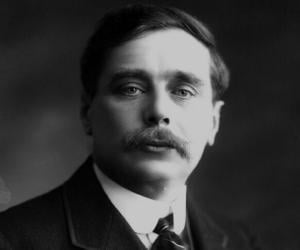
Also Known As: Herbert George Wells
Born in: Bromley, Kent, England
Spouse/Ex-: Amy Catherine Robbins (1895–1927), her death), Isabel Mary Wells (1891–1894)
father: Joseph Wells
children: Anthony West, G. P. Wells
place of death: London, England
Founder/Co-Founder: Diabetes UK
education: Royal College of Science, Imperial College London
Recommended For You
Who was H. G. Wells?
Herbert George Wells, often referred to as H. G. Wells, was an English writer best known for his science fiction works that gave a vision of the future. He was well-known for being proficient in many other genres as well, and had written several novels, short stories, biographies, and autobiographies. An avid reader since a very young age, he read books by Washington Irving, Charles Dickens, Jonathan Swift, Voltaire, and many other important writers of the Enlightenment period. His works were influenced by them in some way or the other. While in college, he devoted a lot of his time to writing and one of his short stories about time travel, ‘The Chronic Argonauts’, published in a journal, displayed his talent as an upcoming writer. A futurist, he became a literary sensation with the publication of his novel ‘The Time Machine’. Besides fiction, he wrote social satires, essays, articles, and non-fiction books as well. He also worked as a book reviewer for many years and promoted the careers of other writers like James Joyce and Joseph Conrad. An outspoken socialist, he openly supported pacifist views, and most of his later works were political and pedagogic. Wells was also an artist, and often illustrated the endpapers and title pages of his own works. Even after seven decades of his death, he is remembered as a futurist and a great author.
The Life and Work of H.G. Wells
The prolific author of ‘The Time Machine’ and ‘The War of the Worlds’
:max_bytes(150000):strip_icc()/herbert-george-wells-5a7256ca6bf0690037ca22a1.jpg)
Herbert George Wells, more commonly known as H.G. Wells (September 21, 1866-August 13, 1946), was a prolific English author of fiction and non-fiction. Wells is best-remembered, however, for his famous science fiction novels and uncanny predictions about the future.
Fast Facts: H.G. Wells
Early Years
H.G. Wells was born on September 21, 1866, in Bromley, England. His parents, Joseph Wells and Sarah Neal, worked as domestic servants before using a small inheritance to purchase a hardware store. Known as Bertie to his family, Wells had three older siblings. The family lived in poverty for many years as the store provided a limited income due to poor location and inferior merchandise.
At the age of 7, after Wells suffered an accident that left him bedridden, he became a voracious reader of everything from Charles Dickens to Washington Irving. When the family store finally went under, his mother went to work as a housekeeper at a large estate. It was there Wells was able to expand his literary horizons with authors such as Voltaire.
At the age of 18, Wells received a scholarship to the Normal School of Science, where he studied biology. He later attended London University. After graduating in 1888, Wells became a science teacher. His first book, the «Textbook of Biology,» was published in 1893.
Personal Life
Wells married his cousin, Isabel Mary Wells, in 1891, but left her in 1894 for a former student, Amy Catherine Robbins. The couple married in 1895. Wells’ first fiction novel, «The Time Machine,» was published the same year. The book brought Wells instant fame, inspiring him to embark on a serious career as a writer.
Famous Works
Wells long- and short-form fiction falls into many genres, including science-fiction, fantasy, dystopian fiction, satire, and tragedy. Wells penned plenty of non-fiction, including biographies, autobiographies, social commentaries, and textbooks as well as social commentary, history, biography, autobiography, and recreational war games.
Wells’ 1895 debut, «The Time Machine,» was followed by «The Island of Doctor Moreau» (1896), «The Invisible Man» (1897), and «The War of the Worlds» (1898). All four novels have been adapted for film, however, one of the most famous renditions of a Wells work was by Orson Welles, whose radio adaptation of «The War of the Worlds» was broadcast on October 30, 1938.
The reports that many listeners, not realizing what they were hearing was a radio play rather than a news broadcast and were so terrorized at the prospect of an alien invasion that they fled their homes in fear has since been debunked. However, the panic story was accepted for years and became one of the most enduring urban legends ever perpetrated in the name of a publicity campaign.
Death
H.G. Wells died on August 13, 1946, at the age of 79 of unspecified causes (his death has been attributed to a heart attack or a liver tumor). Wells’ ashes were scattered at sea in Southern England near a series of three chalk formations known as Old Harry Rocks.
Impact and Legacy
H.G. Wells liked to say that he wrote «scientific romances.» Today, we refer to this style of writing as science fiction. Wells’ influence on this genre is so significant that he, along with French author Jules Verne, share the title of «the father of science fiction.»
Wells was among the first to write about such things as time machines and alien invasions. His most famous works have never been out of print, and their influence is still apparent in modern books, films, and television shows.
Wells also made a number of social and scientific predictions in his writing—including airplane and space travel, the atomic bomb, and even the automatic door—that have since come to pass. These prophetic imaginings are part of Wells’ legacy and one of the things he is most famous for.
Quotes
H.G. Wells often commented on art, people, government, and social issues. Here are some characteristic examples:
«I found that, taking almost anything as a starting point and letting my thoughts play about with it, there would presently come out of the darkness, in a manner quite inexplicable, some absurd or vivid little nucleus.»
«Humanity either makes, or breeds, or tolerates all its afflictions, great or small.»
«If you fell down yesterday, stand up today.»
Biography
Overview (4)
| Born | September 21, 1866 in Bromley, Kent, England, UK |
| Died | August 13, 1946 in London, England, UK (diabetes and liver cancer) |
| Birth Name | Herbert George Wells |
| Nickname | The Man Who Invented Tomorrow |
Mini Bio (2)
Writer, born in Bromley, Kent. He was apprenticed to a draper, tried teaching, studied biology in London, then made his mark in journalism and literature. He played a vital part in disseminating the progressive ideas which characterized the first part of the 20th-c. He achieved fame with scientific fantasies such as The Time Machine (1895) and War of the Worlds (1898), and wrote a range of comic social novels which proved highly popular, notably Kipps (1905) and The History of Mr Polly (1910). Both kinds of novel made successful (sometimes classic) early films. A member of the Fabian Society, he was often engaged in public controversy, and wrote several socio-political works dealing with the role of science and the need for world peace, such as The Outline of History (1920) and The Work, Wealth and Happiness of Mankind
H.G. Wells, born in the London suburb of Bromley in 1866, began his literary career in earnest in 1895 with the publication of his first novel, «The Time Machine.» Until this first success his life had been a patchwork of unsatisfactory drapery and chemist apprenticeships that were interrupted by stints as a teacher’s assistant, and eventually acceptance into London’s Normal School of Science where he studied biology under Darwin’s «bull dog,» the great T.H. Huxley.
The 1890’s saw the publication of the «scientific romances» that were to make him the most successful author of his time. Following «The Time Machine» was «The Island of Dr. Moreau» (1896), «The Invisible Man» (1897), «The War of the Worlds» (1898), «When the Sleeper Wakes» (1899), and «The First Men in the Moon» (1901). After this point he turned his prolific pen to social topics, history, and even a bit of hopeful prophecy with books like «Anticipations» (1901), «The Discovery of the Future» (1902), «Mankind in the Making» (1903), «The Future in America» (1906), «The War in the Air» and «New Worlds for Old» (1908), «What is Coming» (1916), «War and the Future» (1917), «The Salvaging of Civilisation» (1921), «The Open Conspiracy» (1928), «The Shape of Things to Come» (1933), and «The New World Order» (1939).
A revolutionary in thought and deed, Wells was often the subject of public controversy owing to his attitude on so-called «free love» and women’s rights. He was also a life-long believer in Socialism as the means to mankind’s ultimate social salvation. His particular brand had nothing to do with the retrogressive Marxist strain and also helped bring him in conflict with other leading Socialist thinkers of his day during his brief stint with The Fabian Society. The outbreak of the First World War found a heretofore pacifist Wells changing his mind to support of this Great War against the Hohenzollern «Blood and Iron» Imperial aggression. He reacted by writing a pamphlet in 1914 addressing the anti-war and pacifist elements in Britain entitled «The War That Will End War.» Its title became proverbial almost instantly and is used to refer to the First World War even today. After spending time with the British government’s War Office in the Propaganda Department and helping to define a clear set of war aims, he resigned and returned to writing propaganda his way.
Even before the Great War began he published «The World Set Free» early in 1914. It was a prophetic novel about a world war against Imperial Germany and her «Central European Allies» which included a remarkably accurate forecast of atomic warfare and even coined the term «atomic bomb.» He was among the first to call for a post war League of Nations but was bitterly disappointed with and critical of the actual League that developed. He spent the early part of the 1920’s writing «The Outline of History,» which like so many of his previous works was also enormously successful on both sides of the Atlantic.